
English| EUR
Suggested for you
More currencies
Choose a language
The bamboo corridor above Kipahulu is one of the few places on the island where the sound of the forest arrives before the view does. This maui bamboo forest waterfall hike guide covers what the Pipiwai Trail actually demands — daylight, footing, and a weather eye. Read it before the drive, not on the trailhead.
Quick answer
The Kipahulu District of Haleakala National Park is open 09:00–17:00 daily, and the Pipiwai Trail is a four-mile round trip that most hikers complete in two and a half to four hours. Entry is 30 USD per private vehicle, valid three days. The binding constraint is daylight and rain: heavy upstream showers can close stream crossings without warning.
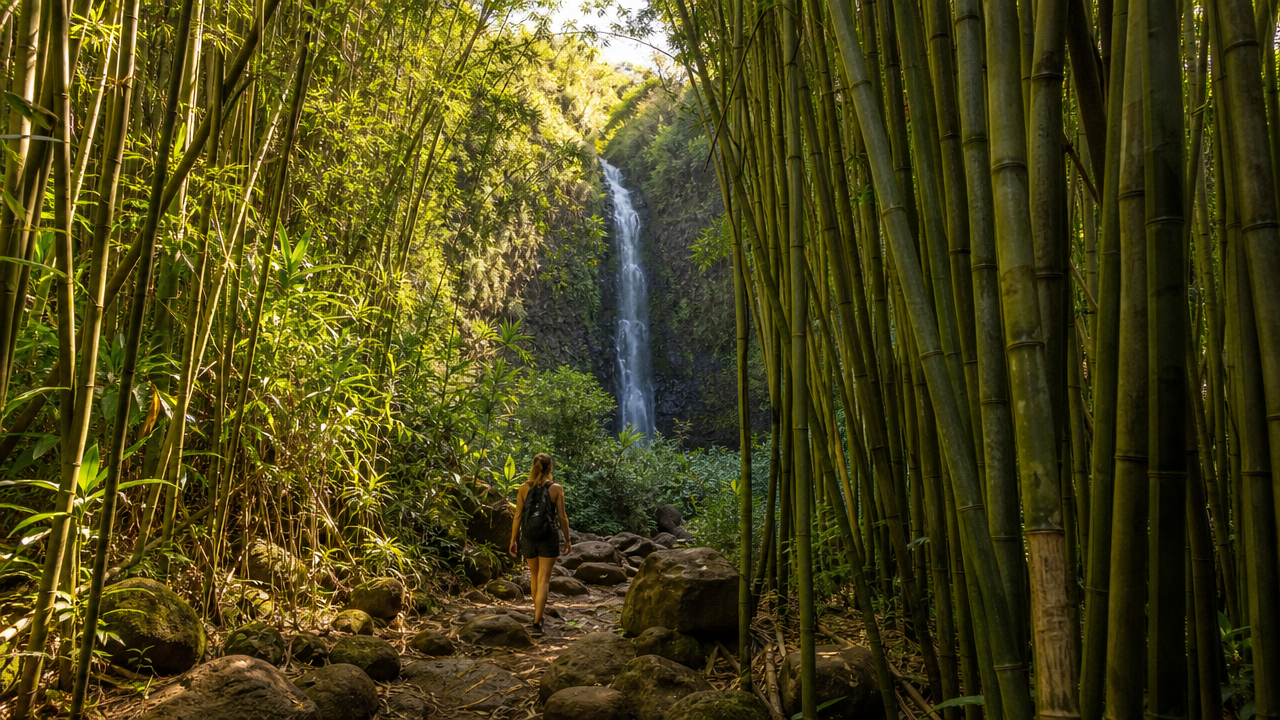
The bamboo along the upper Pipiwai Trail is not native. It is a naturalized stand that has grown into a corridor so dense that the canopy holds its own weather, dropping the light and the temperature within a few paces of entering. Culms knock together in the wind with a hollow, percussive sound that carries further than the boardwalk itself. It is the reason most people come, and it sits roughly two-thirds of the way along a route that also passes a banyan, a bridge over the Palikea Stream gorge, and the 200-foot drop of Makahiku Falls. The maui bamboo forest waterfall hike begins at the Kipahulu Visitor Center on the far southeastern coast of the island, in Haleakala National Park — a detail that catches out visitors who assume the park means only the summit crater. Kipahulu is a separate district, reached along the Hana Highway, and there is no road connecting it to the summit area. The trail climbs steadily on packed dirt, exposed root, and rock, gaining about 650 feet to the base of Waimoku Falls. None of it is technical. All of it is slick after rain, and rain here is measured in feet per year, not inches. That rainfall is the governing fact for anyone planning this Maui waterfall hike. The Palikea Stream drains a saturated upland, and water levels at the crossings can rise sharply from storms that never touch the trailhead. Rangers close sections when conditions warrant, and the Ohe'o Gulch pools below are frequently off-limits to swimming for the same reason. Checking conditions by phone before committing to the drive is standard practice among people who hike this trail regularly. What to do with all this: treat the day as a full commitment rather than a stop. The approach along the Hana Highway is slow by design, the district gates operate on a fixed daily schedule, and there are no facilities beyond the visitor center — no shop, no reliable cell signal, no water resupply on the trail. Carry more water than the distance suggests, wear tread you trust on wet basalt, and start early enough that a slow descent is not a problem. Planned that way, the maui bamboo forest waterfall hike is a straightforward half-day. Planned badly, it becomes a race against a closing gate on an unlit road.
“Rain here is measured in feet per year, not inches — and the stream does not wait for the forecast to catch up.”
The Kipahulu District of Haleakala National Park, home to the bamboo forest and Pipiwai Trail, is open seven days a week.
The Pipiwai Trail is located in the Kipahulu District of Haleakala National Park, accessible via the Hana Highway (Highway 360). Visitors should drive toward the east side of Maui, passing the town of Hana before reaching the trailhead parking area.
Hana Highway (Highway 360) to Kipahulu District
Driving from Hana town
Park at Kipahulu Visitor Center lot
Parking is located directly at the Kipahulu Visitor Center. Ensure you follow all directional signs within the park to reach the designated trailhead parking area.
This is the walking sequence for the Pipiwai Trail, which climbs about four miles round trip from the Kipahulu trailhead through the bamboo forest to the base of Waimoku Falls. Most hikers take two and a half to four hours end to end, depending on stops and trail conditions.
Begin at the marked Pipiwai Trail trailhead in the Kipahulu District of Haleakala National Park, uphill from the visitor center. Walk the trail rather than the road below it, since the two run close together and hikers often start on the wrong path.
About half a mile in, a short signed spur on the right leads to a railed overlook above the 185-foot Makahiku Falls. Stay behind the railing; the grass beyond it hides an unstable cliff edge.
Continue past the sprawling banyan that marks roughly the halfway point to the bamboo. The trail narrows and turns rocky here, so slow down through the exposed roots, which stay slick long after rain.
Two boardwalk bridges carry the trail over Palikea Stream. Look upstream before crossing, and turn back if the water is running high or brown, since flash flooding rises fast in this drainage.
A raised boardwalk runs several hundred yards through dense bamboo where light drops and the stalks knock together. Keep to the planks; the mud alongside them is deep and the side paths are not maintained.
The boardwalk ends and the last stretch crosses rocky ground to the base of the 400-foot Waimoku Falls. Stop at the signed viewing area rather than scrambling into the amphitheater, where falling rock is a constant risk.
Retrace the trail back to the trailhead, allowing roughly an hour to ninety minutes for the descent. Start your return with daylight to spare, as the bamboo section darkens well before the rest of the trail.
The Pipiwai Trail crosses streams fed by a steep, rain-soaked watershed in the Kipahulu District of Haleakala National Park, where water levels can rise within minutes and the ground stays slick under the bamboo canopy. Conduct here protects both hikers and a cultural landscape that the National Park Service actively works to preserve.
Everything you need to know about maui bamboo forest waterfall hike
Preparation for a maui bamboo forest waterfall hike involves wearing sturdy hiking shoes and bringing plenty of water for the humid trek. You should also check weather reports, as the trail can become muddy and slippery during rainfall in the Kipahulu District. The hike takes you through dense vegetation and wooden boardwalks, so staying on the marked path is essential for protecting the local ecosystem.
Access to the Pipiwai Trail requires a 30 USD fee per private vehicle, which grants you entry to Haleakala National Park for three days. This fee is paid at the entrance station to help maintain the park facilities and preserve this beautiful Maui landmark. Please ensure you have a form of payment ready when you arrive at the Kipahulu District entrance.
The park is open daily from 09:00 to 17:00, providing ample time to explore the bamboo forest and nearby sights. Visitors should plan their schedule to ensure they have enough time to hike and exit the area before the gates close at 17:00. Consistency in these opening hours helps manage the flow of visitors throughout the week.
To avoid mid-day crowds and ensure you have enough time to complete the maui bamboo forest waterfall hike, the recommended arrival window is 09:00–11:00. Arriving early allows you to enjoy the quiet atmosphere of the forest before the peak afternoon congestion begins. This timing also provides the best natural light for observing the lush flora and the towering bamboo stalks.
Families often enjoy this maui bamboo forest waterfall hike, though the path features sections of uneven terrain and steps that may challenge small children. Parents should supervise their children closely, especially near cliff edges or fast-moving water areas along the trail. Always carry extra snacks and hydration to keep younger hikers comfortable throughout the excursion.
Safety on this maui bamboo forest waterfall hike requires visitors to remain on designated trails and avoid swimming in restricted pools. Flash floods can occur unexpectedly, so do not cross streams if water levels appear high or rise rapidly. By following posted signs and respecting park boundaries, you help ensure a safe experience for everyone in the Kipahulu District.
Easy Waterfall Hikes in Maui
Read more GuideMaui Waterfall Hikes with Kids
Read more GuideMaui Waterfall Hike Swimming Guide
Read more GuideWaterfall Hikes Near Lahaina
Read more GuideWaterfall Hikes Near Kihei
Read more GuideMaui Waterfall Hikes Map
Read more Tickets & toursGuided Maui Waterfall Hike Tours
Read more GuideTwin Falls Maui Waterfall Hike Guide
Read more